
Important: Vantelyx Labs products are sold strictly for research purposes only. Inquiry regarding human consumption is strictly prohibited.
Neurobiology
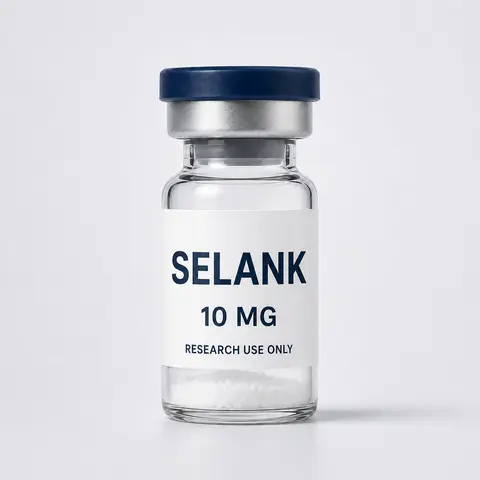
Selank
10 mg
A synthetic tuftsin-derived heptapeptide used in experimental neurobiology to investigate neuropeptide signalling, neuroimmune communication and central nervous system regulatory pathways.
£24.99
Third Party COA tested. Please contact us for reports.
Build Up Add-On available at checkout for £25 per selected item.
Research-use information only. Not presented for human or veterinary administration.
QUALITY ASSURANCE
Third-party COA testing
Third Party COA tested. Please contact us for reports.
ABOUT THE COMPOUND
Description & research context
Selank is a synthetic heptapeptide based on the endogenous immunomodulatory peptide tuftsin. Its sequence and stability profile have made it a research tool for examining neuropeptide signalling and neuroimmune interactions.
Experimental work has explored neurotransmitter-associated pathways, stress-response signalling, gene-expression effects and peptide-receptor interactions. These observations are model-dependent and should be interpreted within the design and controls of each study.
APPLICATIONS IN RESEARCH
Common experimental themes
- Neuropeptide-mediated signalling research
- Neuroimmune interaction and CNS regulatory models
- Studies of peptide stability and signalling behaviour
- Reference work in neurobiology and stress-associated signalling
LABORATORY HANDLING
Handling & stability
- Handle lyophilised material under dry laboratory conditions.
- Select an assay-appropriate aqueous or buffered vehicle.
- Avoid vigorous agitation during dissolution.
- Aliquot where appropriate and minimise repeated freeze-thaw cycles.
- Protect material from prolonged light and elevated temperature.
RESEARCH NOTES
Interpretation & precautions
- Neuronal model, receptor expression and exposure conditions influence observed responses.
- Buffer composition and pH may affect peptide stability.
- Appropriate controls are recommended when comparing signalling endpoints.
- For laboratory research use only.
REFERENCE READING