
Important: Vantelyx Labs products are sold strictly for research purposes only. Inquiry regarding human consumption is strictly prohibited.
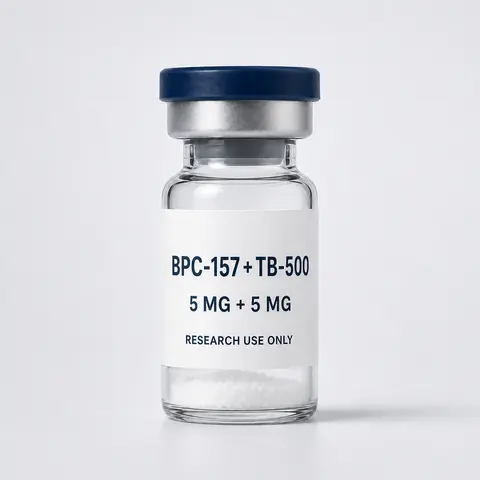
Dual-peptide research blend
BPC-157 + TB-500
10 mg total
A 10 mg dual-peptide research blend containing 5 mg BPC-157 and 5 mg TB-500 for controlled comparative work across short-peptide signalling, actin dynamics and cell-migration models.
£26.99
Third Party COA tested. Please contact us for reports.
Build Up Add-On available at checkout for £25 per selected item.
Research-use information only. Not presented for human or veterinary administration.
QUALITY ASSURANCE
Third-party COA testing
Third Party COA tested. Please contact us for reports.
ABOUT THE COMPOUND
Description & research context
This research blend contains two separately designated peptide materials in one 10 mg vial: 5 mg BPC-157 and 5 mg TB-500. It is presented for controlled comparative studies where a fixed 1:1 labelled-mass composition is useful to the experimental design.
BPC-157 is commonly examined in short-peptide and cell-signalling models, while TB-500 is associated with actin-binding and cell-migration research. Results from a combined preparation require suitable controls because component identity, concentration and assay conditions can each affect interpretation.
APPLICATIONS IN RESEARCH
Common experimental themes
- Comparative BPC-157 and TB-500 pathway research
- Short-peptide signalling and actin-dynamics models
- Cell migration and cell-matrix interaction studies
- Analytical verification of two-component peptide preparations
LABORATORY HANDLING
Handling & stability
- Handle dry lyophilised material using standard laboratory technique.
- Select an aqueous or buffered vehicle appropriate to the assay design.
- Avoid vigorous agitation during dissolution.
- Use aliquots where suitable and minimise repeated freeze-thaw cycles.
- Protect prepared material from prolonged light and elevated temperature.
RESEARCH NOTES
Interpretation & precautions
- Use single-component controls where the study needs component-specific interpretation.
- Appropriate positive and negative controls are recommended for signalling studies.
- Reference literature is mechanistic and preclinical; observations are not clinical outcomes.
- For laboratory research use only.
REFERENCE READING